
The Crash-Reset Cycle: Why You Keep Powering Through Then Falling Apart
Push hard → crash → drink → shame → repeat. This is the crash-reset cycle. Here's how to break it.

Have you ever noticed this pattern?
You push hard for weeks. Maybe months.
You hold it together. You function. You show up. You say no to the drink.
And then one day, you just... crash.
Not because something catastrophic happened. But because you’ve been running on fumes for so long that your body finally gives out.
And when you crash, you reach for the thing that’s always been there: alcohol.
Then you feel shame. You beat yourself up. You promise yourself you’ll do better.
And the cycle starts again.
Push hard → crash → drink → shame → repeat.
This is the crash-reset cycle.
And it’s not just about drinking. It’s about how you do everything.
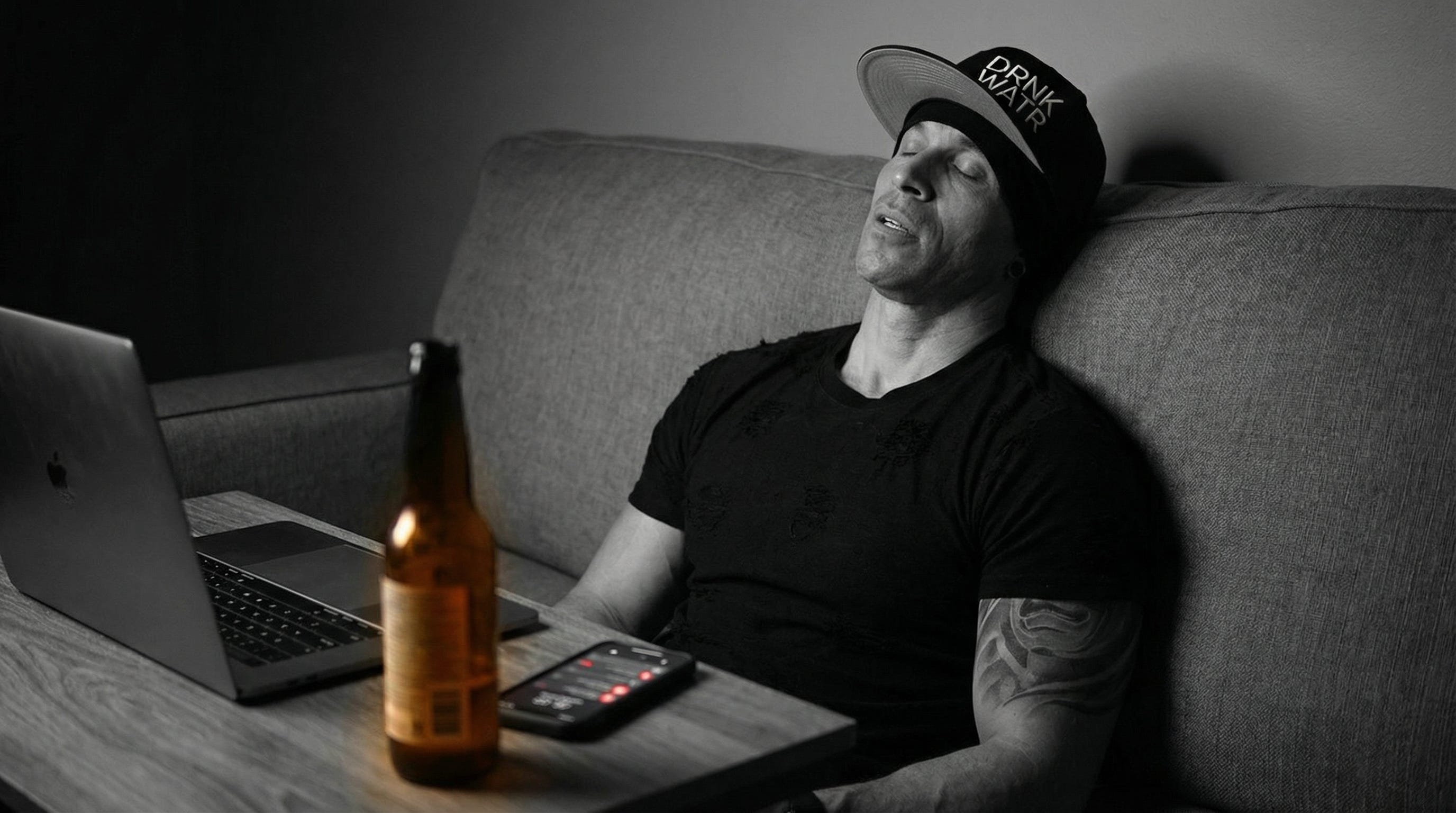
You’re Not Lazy When You Crash. You’re Just Finally Listening.
Here’s what most people don’t understand about the crash-reset cycle:
The crash isn’t a failure. It’s your nervous system screaming for regulation.
You’ve been powering through stress, anxiety, overwhelm, dysregulation for weeks.
Your body has been saying: “We need to slow down. We need to regulate. We need rest.”
But you ignored it. Because you thought powering through was strength.
So your nervous system did the only thing it could: it forced a shutdown.
The crash isn’t weakness. It’s your body protecting you from yourself.
But here’s the problem: You don’t know how to crash in a healthy way.
You don’t know how to rest without shame. You don’t know how to regulate without alcohol.
So when you crash, you reach for the reset button you’ve always used: the drink.
And the cycle continues.
The Belief System That Keeps You Stuck
Have you ever blamed someone else for your struggle?
When was the last time you crashed and thought: “If only I had more support. If only someone gave me what I needed. If only life wasn’t so hard.”
That’s not victimization. That’s a belief system.
You BELIEVE you’re a victim. And your brain makes it true.
Here’s how it works:
Your brain has something called the Reticular Activation System (RAS).
It’s the filter that decides what information you pay attention to.
And it looks for proof of whatever you tell it.
If you tell your brain: “I’m a victim. Life is hard. People don’t support me enough.”
Your RAS goes to work. It scans your environment for evidence to prove that belief true.
Someone doesn’t text you back? Proof you’re not supported.
A session doesn’t go exactly how you wanted? Proof you’re not getting what you need.
You crash after powering through? Proof life is too hard for you.
Your brain finds evidence for whatever belief you practice.
And the more evidence it finds, the more you believe it.
And the more you believe it, the more your nervous system generates the FEELING of being a victim.
You feel weak. You feel unsupported. You feel entitled to blame someone else.
Not because it’s true. But because you practiced believing it.
The Pattern Shows Up Everywhere (Including How You Ask for Help)
Let me tell you about a client I just had to fire.
She was on the lowest tier of coaching: $50/week. 30-minute check-ins. Continuous support through the week.
I designed this tier specifically for people who don’t have a lot of money but still need support.
And I knew people would take advantage of it.
Here’s what happened:
Every 30-minute session turned into 2 hours.
I wrote character letters on her behalf for lawyers and doctors.
I accommodated her financial situation and over-delivered in ways I don’t even do for $22,000 clients.
I gave her everything.
You know what she did with it?
Nothing.
She didn’t do the program. She didn’t lower her drinking. She didn’t follow through on anything.
And then she blamed ME for not giving her enough time.
She BELIEVED she was a victim. So her brain made her one.
Her RAS scanned every session for proof that she wasn’t getting enough.
And it found it. Because that’s what it was looking for.
She didn’t want transformation. She wanted me to transform FOR her.
She wanted the crash to be MY responsibility. So when she failed, it wouldn’t be her fault.
That’s the crash-reset cycle.
Power through by outsourcing responsibility → crash → blame externally → reset via victimhood → repeat.
I refunded her. Upgraded her membership. Blocked her.
So now she has even more tools to continue ignoring.

The $50 vs $22,000 Pattern
Here’s something I’ve noticed across six tiers of coaching:
People who spend $50 expect $22,000 in value.
People who spend $22,000 expect $50 in value.
Why?
Because one group is practicing victimhood. The other is practicing ownership.
The $50 client believes:
“I don’t have much, so YOU owe me more.”
“My struggle entitles me to extra.”
“Because I’m suffering, you should suffer for me.”
The $22,000 client believes:
“I invested, so I’ll extract every ounce.”
“My success is MY responsibility.”
“You gave me the tools. I’ll use them.”
This is the same pattern as drinking.
People who want a quick fix → power through → crash → blame.
People who invest deeply → do the work → sustain → succeed.
Have You Ever... (Check Yourself)
Have you ever started something with massive motivation, only to quit within weeks?
Have you ever blamed your circumstances for why you can’t change?
Have you ever felt like life is just harder for you than it is for other people?
Have you ever thought: “If only I had more support, more time, more money, more energy... THEN I could do this”?
Have you ever crashed and immediately reached for alcohol to reset?
Have you ever felt entitled to something you didn’t earn because you’ve “been through so much”?
That’s the crash-reset cycle. And it’s tied to your identity.
Your Identity Is a Practiced Belief System
You’re not a victim. But you practiced believing you are.
Every time life got hard and you thought “this is too much for me,” you practiced victimhood.
Every time you crashed and blamed external circumstances, you practiced avoiding accountability.
Every time you expected someone else to do the work for you, you practiced entitlement.
And your nervous system dysregulated around that belief.
Because when you believe you’re a victim, your nervous system generates the FEELING of being powerless.
Your body tenses up. Your thoughts race. You scan for threats. You expect failure.
You’re not powerless. But your dysregulated nervous system makes you FEEL powerless.
And when you feel powerless, you act powerless.
You don’t do the work. You don’t follow through. You crash. You blame.
Your belief system creates your nervous system state. Your nervous system state creates your behavior.
This is why willpower doesn’t work.
Because willpower is a conscious effort to override your identity.
But your identity is running in your autonomic system. It’s automatic. It’s been practiced for years.
The crash-reset cycle isn’t a habit. It’s who you’ve practiced being.
Why You Keep Powering Through (Instead of Building Sustainable Rhythm)
Have you ever asked yourself: “Why do I always do this to myself?”
Here’s why:
You believe that suffering = progress.
You believe that if you’re not pushing hard, you’re not doing enough.
You believe that rest = weakness.
These are practiced beliefs. And your RAS finds proof for them.
When you rest, you feel guilty. Proof that rest = weakness.
When you power through and crash, you feel like you “tried hard.” Proof that suffering = effort.
Your brain is looking for evidence that you need to keep suffering.
So you do.
You power through until you crash. You crash until you drink. You drink until you shame yourself. You shame yourself until you power through again.
The cycle is your identity.
The Nervous System Explanation
Here’s what’s actually happening in your body:
When you power through, you’re running your nervous system on high alert.
Your body is in constant fight-or-flight. Cortisol flooding. Adrenaline pumping. No regulation.
You can power through for a while. But your nervous system has limits.
Eventually, it forces a shutdown. That’s the crash.
Your body literally cannot sustain high alert anymore. So it collapses.
But you don’t know how to regulate BEFORE the crash.
You don’t know how to notice when your nervous system is dysregulated.
You don’t know how to slow down before you burn out.
So you wait until your body forces you to stop. And by then, you’re so depleted that the only reset button that works is alcohol.
The crash-reset cycle is a dysregulation cycle.
And you can’t willpower your way out of dysregulation.
Building Sustainable Rhythm (Instead of Crash Cycles)
Have you ever noticed that the most successful people don’t power through?
They build rhythm.
They regulate their nervous system BEFORE it forces a shutdown.
They rest without guilt. They slow down without shame.
They don’t wait for the crash. They prevent it.
Here’s how:
1. Notice When You’re Dysregulated (Before the Crash)
Your body gives you signals long before the crash:
Chest tightness
Racing thoughts
Irritability
Shallow breathing
Fatigue that coffee can’t fix
These aren’t signs you need to push harder. They’re signs you need to regulate.
2. Build Regulation Into Your Routine (Not Just When You Crash)
Don’t wait until you’re falling apart to rest.
Build regulation into your daily rhythm:
Morning meditation (regulate BEFORE the day dysregulates you)
Breathwork throughout the day (reset your nervous system in real-time)
Movement (burn off stress hormones before they accumulate)
Boundaries (say no before you’re overwhelmed)
Your routine is your safety net.
3. Rest Without Shame
Rest isn’t weakness. Rest is regulation.
When you rest, your nervous system shifts from fight-or-flight to safe mode.
Your body heals. Your thoughts clear. Your energy restores.
You can’t power through forever. You have to build in rest.
And if you feel guilty when you rest? That’s your practiced belief system.
Your RAS is looking for proof that rest = weakness.
Practice a new belief: Rest = strength.
4. Stop Outsourcing Your Responsibility
Have you ever expected someone else to save you?
A coach. A therapist. A program. A partner.
You can have support. But you can’t outsource the work.
When you expect someone else to transform you, you’re setting yourself up for the crash-reset cycle.
Because when you crash, you’ll blame them for not doing enough.
Your transformation is YOUR responsibility.
Support helps. But it doesn’t do the work for you.
The Identity Shift
Here’s what needs to change:
You need to stop practicing the belief: “I’m someone who powers through then crashes.”
And start practicing: “I’m someone who regulates before I dysregulate.”
You need to stop practicing the belief: “Life is too hard for me.”
And start practicing: “I’m capable of handling what life gives me.”
You need to stop practicing the belief: “I’m a victim of my circumstances.”
And start practicing: “I’m the author of my life.”
Your RAS will find proof for whatever you practice believing.
So practice believing something that serves you.
When Was the Last Time You Blamed Someone Else?
Ask yourself:
When was the last time you crashed and blamed:
Your job for being too stressful
Your partner for not being supportive enough
Your circumstances for being too hard
A coach/therapist for not giving you enough
That’s your practiced belief system talking.
And your dysregulated nervous system is making it FEEL true.
But feeling true doesn’t make it true.
You’re not a victim. You’re just dysregulated.
And dysregulation makes you believe you can’t handle what’s in front of you.
Regulate your nervous system. And your belief systems shift.
The Choice
You can keep running the crash-reset cycle:
Power through → dysregulate → crash → blame → drink → shame → repeat.
Or you can build sustainable rhythm:
Regulate daily → notice dysregulation early → rest without shame → take responsibility → sustain.
The difference isn’t willpower. It’s identity.
Are you someone who crashes and resets?
Or are you someone who regulates and sustains?
You get to choose. But you have to practice the new identity until your nervous system believes it.
If you’re ready to stop the crash-reset cycle and build sustainable rhythm, take the Beyond Sober assessment: beyondsoberscan.com
If this hit you, share it with someone who’s stuck in the power-through-then-crash cycle.
See you next time.
— Kohdi
THE CRASH–RESET CYCLE
I used to push hard just to outrun how I felt.
Then I’d crash, feel shame, and tell myself I’d failed.
One slip meant, “I’ve blown it.”
That was the lie.
Now I pause.
Reset at the next opportunity.
No piling on.
I speak to myself with love —
like I would a mate who’s trying his best.
Better habits are sticking now
because I’m steady, not extreme.
The rest just need time.
I can help others by example —
but I can’t make them change.
You can lead a horse to water,
but you can’t make it drink.
My job is to keep changing me.
Steady. Honest. One choice at a time.
Well said, Khodhi.
This article was eye opening in a life-changing way. I wrote bullet points on a notecard and will carry it with me to practice until I am able to do this - then keep practicing more! Thank you for sharing your knowledge and experience in a practical, straightforward way.